
Does Event Match Quality Actually Affect ROAS? What 29 Meta Accounts Showed Us
If you have been spending time trying to move an account from 8.3 to 9.0, this is the post that tells you to stop, and where to put that time instead.
We are a performance agency, so we hold pixel access to dozens of Meta accounts across food, beverage, supplements, pet, beauty, alcohol, and hard-goods ecommerce. That is a rare vantage point. EMQ is private to each advertiser, so almost nobody gets to look at it across a whole portfolio at once. We did, and the answer was cleaner than we expected.
What is Event Match Quality (EMQ)?
Event Match Quality is a score from 0 to 10 that Meta assigns to your conversion events. It measures how confidently Meta can tie an event you send (a purchase, an add to cart) back to a real person on Facebook or Instagram. The more strong identifiers each event carries, like a hashed email, phone number, click ID, or IP, the higher the score.
Here is how the bands break down, per CustomerLabs' 2026 EMQ guide:
| EMQ band | Score | What it means |
|---|---|---|
| Poor | Below 4 | Meta can barely match your events. Optimization is guessing. |
| OK | 4 to 5.9 | Signal exists but is noisy. You feel it as unstable CPA. |
| Good | 6 to 7.9 | Floor for reliable optimization. Fine for most events, light for Purchase. |
| Great | 8 to 8.9 | The target for high-intent events like Purchase. |
| Elite | 9+ | Well-instrumented Conversions API, hashed data on every event, clean dedup. |
One thing that trips people up: EMQ is not one number. It is scored per event. A browser-pixel-only setup usually caps around 3 to 5, because a page view only carries an IP and a browser ID. A purchase carries an email and a phone number, so it scores much higher on the same account. When someone quotes a scary low EMQ, they are almost always looking at a top-funnel event, not the purchase.
The claim we set out to test
The prevailing belief in performance marketing is that raising EMQ raises ROAS. You will see vendor case studies claiming that campaigns with high EMQ see roughly 28% more conversions and a 17% ROAS lift, and that nudging a score from 8.6 to 9.3 pays for itself. We pulled the current EMQ on every Meta account we have access to and lined it up against 90 days of ROAS. Here is the claim next to what we actually found.
| What the industry claims | What our 29 accounts showed |
|---|---|
| Higher EMQ means higher ROAS | No measurable link. Across the accounts we could pair, the EMQ-to-ROAS correlation was r = -0.10. |
| Push EMQ from 8.6 to 9.3 for a ~22% ROAS lift | Every live account already scored 7.3 to 9.3 on Purchase. The variance to chase does not exist. |
| EMQ is a growth lever | EMQ is a floor. Below ~7 it hurts. Above it, more points did nothing for ROAS. |
| A high EMQ proves clean measurement | Two accounts scored 9+ while their purchase ROAS read near zero, because the tracked event was not their real conversion. |
What we found across 29 accounts
EMQ is already high everywhere that matters
Fifteen of the accounts exposed a scored Purchase EMQ. Every single one landed in Meta's Great or Elite range. The mean was 8.3, the median was 8.3, and the whole set fit inside a two-point band from 7.3 to 9.3.
That is the core finding. On live, well-run accounts, EMQ is a solved problem. There is barely any variance left to correlate against ROAS in the first place.
The accounts where we could measure both
We pulled Meta's own reported purchase ROAS directly from each account, not a third-party estimate, and paired it with the Purchase EMQ. Six accounts had clean data on both sides, across four different verticals. Here is what they showed.
| Account (anonymized) | Vertical | Purchase EMQ | Meta ROAS (90d) |
|---|---|---|---|
| A | Food DTC | 9.1 | 2.15x |
| B | Beverage DTC | 8.4 | 1.95x |
| C | Hard-goods ecommerce | 8.3 | 8.16x |
| D | Hard-goods ecommerce | 8.3 | 2.92x |
| E | Personal care DTC | 8.1 | 1.48x |
| F | Hard-goods ecommerce | 8 | 2.70x |
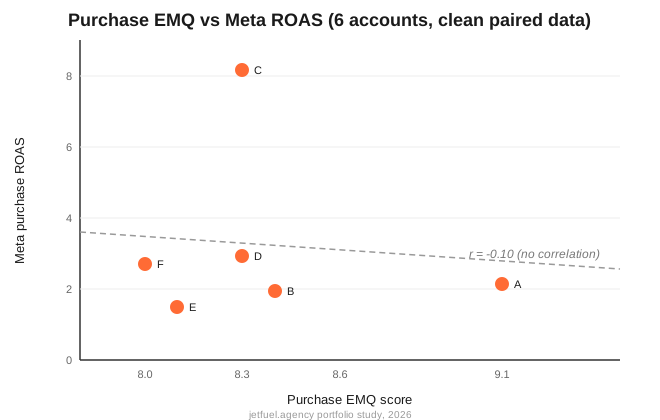
The correlation is flat. Run the numbers and you get a Pearson r of -0.10, which is statistically indistinguishable from no relationship. The highest EMQ in the group (9.1) sits at a middling 2.15x. The highest ROAS (8.16x) comes from an account in the middle of the EMQ range. If EMQ were the lever people treat it as, the points would climb left to right. They do not.
EMQ is event-dependent, so the headline number lies
The same accounts that score 8 to 9 on Purchase score far lower up the funnel, because a page view simply carries less identity than a checkout.
| Event | Typical EMQ range | Mean across our accounts |
|---|---|---|
| Purchase | 7.3 to 9.3 | 8.3 |
| PageView (top funnel) | 4.8 to 7.0 | ~5.6 |
So the account that looks like it has a 5.6 EMQ problem often has a perfectly healthy 9.1 on the event that actually optimizes the campaign. Three accounts in our set showed no scored Purchase event at all, which reads as bad EMQ but really means nobody wired up the conversion event.
Why EMQ doesn't move ROAS once you clear the floor
Any account running a standard checkout plus Conversions API clears Purchase EMQ at 8 without trying, because the purchase event inherently carries an email and a phone number. The variance that is left, say 7.4 versus 9.3, is tiny next to the things that actually decide ROAS: the offer, average order value, the creative, the vertical, and where in the funnel you are spending.
A great EMQ score and a mediocre ROAS live together comfortably, because ROAS is won on offer and creative.
Meta's own documentation is careful here. The Conversions API best practices say that higher matching quality produces better results, but they stop at qualitative. Even the analytical write-ups that push EMQ note the catch: a high score built on unreliable data produces the score without the performance. The number is an estimate of Meta's ability to match, not a guarantee that the match makes you money.
The EMQ Floor Test
This is the check we run instead of chasing a score. We call it the EMQ Floor Test, because EMQ behaves like a floor you either clear or you do not. Know which end of the scale you are on, then act accordingly.
Below the floor: An account with no Conversions API, missing match keys, or no purchase event genuinely bleeds performance. Meta reports it plainly: a browser-only setup caps around 3 to 5, and running both Pixel and CAPI gives it more complete and reliable data sharing. That fix is real and worth doing on day one.
At the floor and up: Once Purchase is at 7-plus and CAPI is feeding it, the returns flatten fast. Moving from 8.3 to 9.0 is effort with almost nothing on the other side of it.
Check the Purchase event, not PageView
Open Events Manager and read the EMQ on your Purchase event specifically. A low PageView score is normal and is not the number that optimizes your campaigns.
Confirm it clears the floor (7 or higher)
If Purchase EMQ is 7 or higher, you have passed. If it is below 7, check that Conversions API is live and that hashed email and phone are being sent on the purchase event.
Verify deduplication
Make sure the pixel and Conversions API dedupe on the same event ID, so you are not double-counting or starving the match.
Stop, then audit your ROAS attribution
Once Purchase EMQ clears the floor, stop optimizing it. Spend the time confirming your ROAS is attributed to the right channel, which is where we found the real signal problem.
The harder problem nobody is auditing
What actually slowed this study down was not EMQ. In more than half the accounts we looked at, the ROAS figure itself could not be trusted.
And it is not only third-party reporting. When we pulled Meta's own purchase ROAS, two of our highest-EMQ accounts, both scoring 9-plus, came back with near-zero purchase ROAS on heavy spend. Their pixels were pristine. The catch is that a website purchase is not what those brands optimize toward. One is retail-first, one runs on a different conversion event. The EMQ was perfect and the metric was measuring the wrong thing.
The signal that everyone obsesses over, EMQ, was clean and current on nearly every live account. The signal that actually decides whether you can make a good decision, a trustworthy ROAS on the right event, was the broken one. That is the 2026 signal problem worth your attention.
How we ran this
Population: 48 Meta accounts under our pixel access, narrowed to 29 distinct brand accounts after removing duplicates, closed, and internal accounts.
EMQ: Meta's dataset quality read per account, web channel, current snapshot (Meta exposes no EMQ history).
ROAS: Meta's own platform-reported purchase ROAS, pulled directly from each account's insights over a trailing 90-day window. Where we had a second source, the two agreed within 0.02, which is why we trust these figures despite the reporting gaps elsewhere.
Correlation: Pearson r = -0.10 across the six accounts with clean paired EMQ and ROAS.
Anonymization: Client names removed and grouped into coarse verticals, so no brand is identifiable.
Limitations worth stating out loud. This is a cross-sectional snapshot, because Meta only exposes current EMQ and no history, so we cannot watch ROAS move as EMQ moves inside one account over time. The clean pairs number six, across four verticals, which is broader than a single-category read but still a modest sample, so treat r = -0.10 as directional rather than a published coefficient. The strongest evidence here is not the six pairs. It is that 15 accounts all landed in a two-point EMQ band while their returns ranged more than 5x. That is a variance problem no correlation can rescue.
Frequently asked questions about EMQ and ROAS
What is a good EMQ score?
For most events, 6 or higher is reliable. For Purchase, aim for 8-plus. Below 4 means Meta can barely match your events and your optimization is essentially guessing, so that is the number to fix first. Above the floor, higher is nice but not worth chasing.
Does improving EMQ increase ROAS?
Only when you are moving it out of the broken zone. Going from a 3 to a 7 by adding Conversions API and proper match keys will help Meta optimize. Above that floor, we found no payoff: across the accounts we manage, the correlation between Purchase EMQ and Meta ROAS was r = -0.10, effectively zero. The offer and the creative move ROAS far more than the last point of EMQ.
What is a good EMQ for purchase events specifically?
Target 8 or higher. A checkout naturally carries an email and a phone number, so a well-instrumented purchase event lands in the Great band without much effort. If your Purchase EMQ is stuck below 6, that usually points to a Conversions API gap or missing hashed customer data, not a lost cause.
If my EMQ is already high, is Conversions API still worth it?
Yes. The reason is durability. CAPI keeps your purchase signal alive as browsers keep restricting the pixel, so it protects the score you already have. If you run Pixel plus CAPI and sit at 8-plus, you are done. Reallocate the effort to creative testing and offer work.
What is the EMQ Floor Test?
It is our name for the pass or fail check that replaces chasing a score. Read your Purchase event's EMQ, confirm it is 7 or higher with Conversions API feeding it and dedup clean, then stop. Below the floor, fix it. Above the floor, spend your time verifying that ROAS is attributed to the right channel and the right event.
The takeaway
EMQ is a floor you clear once, not a dial you keep turning. Run the EMQ Floor Test: Purchase event past 7, Conversions API feeding it, dedup clean, then stop. Across the accounts we manage, the correlation between EMQ and ROAS was r = -0.10. A great score and a mediocre ROAS live together comfortably, because ROAS is won on offer and creative.
If you want to spend signal-engineering time well in 2026, spend it making sure you can trust your ROAS number at all. That is the audit almost nobody is running.
Want to know if your Meta signal is actually clean, or just scoring well?
We run a signal audit on Meta accounts that checks EMQ, purchase coverage, deduplication, and whether your ROAS is being attributed to the right channel. We will tell you what is real and what is noise.
Talk to our teamStill have questions?
Let your AI
pressure-test us.
Ask the assistant you already trust.
What does Jetfuel Agency's analysis in "Does Event Match Quality Actually Affect ROAS? What 29 Meta Accounts..." show about its expertise?
Launch into Success
Tell us a bit about yourself and your business. We are just one message away from the perfect partnership!